Olkiluoto’s current Visitor Centre is already twenty years old
Time really flies when you’re having fun. Built in a prime location from the perspective of visibility to the power plant area, the Olkiluoto Visitor Centre has been offering experiences to its guests for a full two decades. It first opened its doors on 1 February 2006.
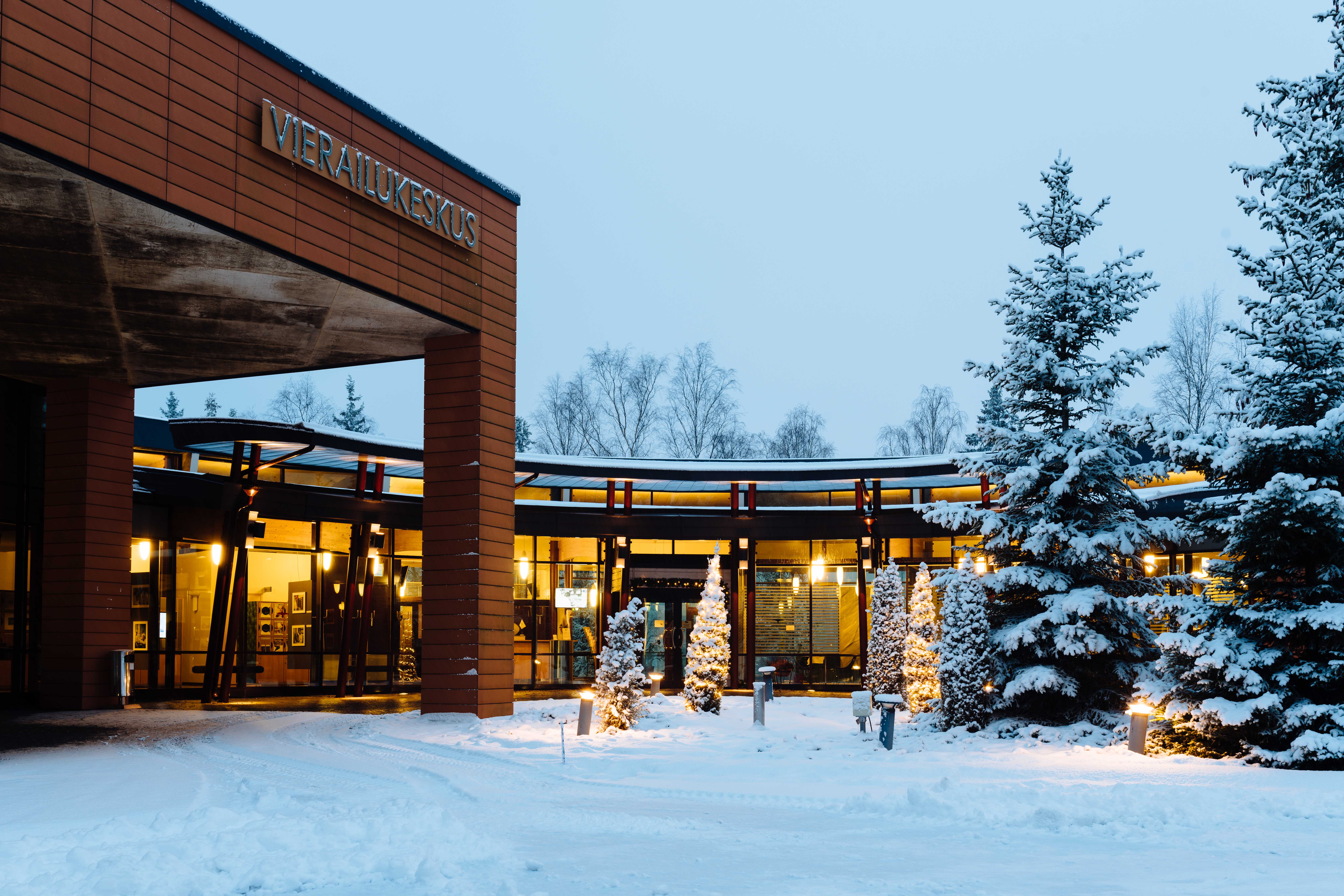
The Visitor Centre has remained consistently popular throughout its history. Proof of this is the fact that more than 17,000 visitors came to see it last year alone. That is a remarkable number, especially considering Olkiluoto’s location. Virtually no one ends up there by chance. Anyone who gets the idea of visiting Olkiluoto while driving along Highway 8 has to make a deliberate detour of more than 20 extra kilometres back and forth.
Visitor activities began already during the construction phase
Although the current Visitor Centre has now reached its twentieth anniversary, it was not the first of its kind. The very first information office introducing Olkiluoto to the public opened as early as 1975—before a single watt of nuclear power had been produced at the site.
At the time, the “information office” was a temporary barrack standing next to the construction pit. Communications Manager Taina Engros and secretary Tuija Pentti, who worked there, took interested visitors on tours of the construction site. As interest was high, an enormous number of tours were eventually conducted.
This approach fit perfectly with the company’s commitment to maximum transparency, which had already been publicly stated in its early years. TVO’s first CEO, Magnus von Bonsdorff, explained this in the company’s history published in 2008:
-Once again, there was loud criticism on a current affairs programme about how industry does not honestly disclose its plans but instead quietly moves along the coast and archipelago acquiring land for itself. I then decided that TVO would do exactly the opposite—that is, we would communicate our plans before taking any concrete action, the former CEO explains.
Visitor activities were one—and unquestionably a significant—part of this chosen policy of openness.
Even the second facility became too small
The modest early barrack was replaced by a more formal Visitor Centre already in the 1980s. That centre was physically located close to the power plant units, and although it was a clear improvement over the original setup, space was still limited. The same building also housed a training centre, which remains there to this day.
Eventually, the walls quite literally began to close in—especially given that visitor numbers had already stabilised well above 10,000 annually. As a result, the company gave the green light for the current Visitor Centre. A prime site was found, along with a generous amount of additional floor space. Designed by architect Aki Alanko, the centre includes not only exhibition areas but also a café, meeting rooms, and an auditorium with seating for over 100 people.
Heureka helped with the exhibition
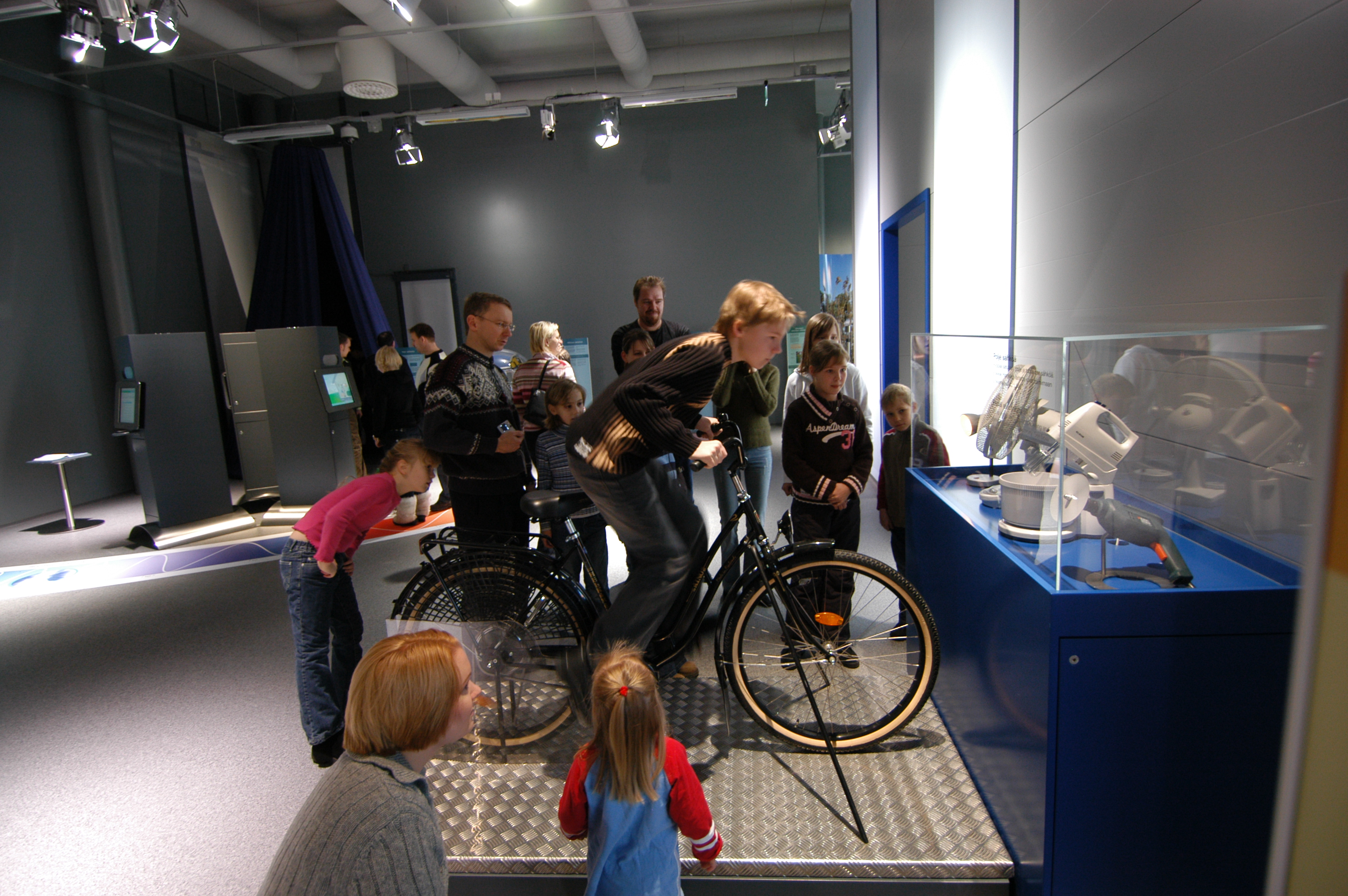
The brand-new Visitor Centre opened its doors on 1 February 2006 and was an instant success. Visitors were also drawn by the specially developed science exhibition Electricity from Uranium, created by the top-level professionals of the Heureka Science Centre. For those who have yet to visit, it is an interactive exhibition that follows the journey of nuclear fuel from rock back to rock. Posiva—the global pioneer in the final disposal of spent nuclear fuel, based in Olkiluoto—is also strongly featured in the story.
From the outset, the exhibition was designed so that it can be explored both with and without a guide. Topics related to uranium and nuclear power are presented through dozens of different interactive stations and devices.
Opening hours to satisfy even demanding visitors
One major advantage of the new Visitor Centre is that, unlike its predecessor, it is located outside the actual plant area. As a result, visiting does not require any special advance arrangements. The science centre is open to casual visitors practically every single day from 10 a.m. to 8 p.m.—including Christmas and Midsummer.
Right next to the Visitor Centre there is also a nature trail presenting the island’s natural environment and the environmental research carried out in the area, which is also extensively covered in the exhibition itself.
As one might expect, the exhibition has been updated several times over the past 20 years, and it is one of those attractions that will never truly be “finished.” Although visitor numbers no longer reach the opening-year peak, they have still hovered around 17,000 annually—matching last year’s total.
You can test your knowledge of the Visitor Centre via this link.
Share