The new fuel transfer machine was put to a real test right at the start of the annual outage
The annual outage carried out at the Olkiluoto 1 plant unit this year will be a long one, up to 55 days. One of the key operations for a successful service outage is connected to the new fuel transfer machine, which arrived last autumn. This will be the first service on the machine.
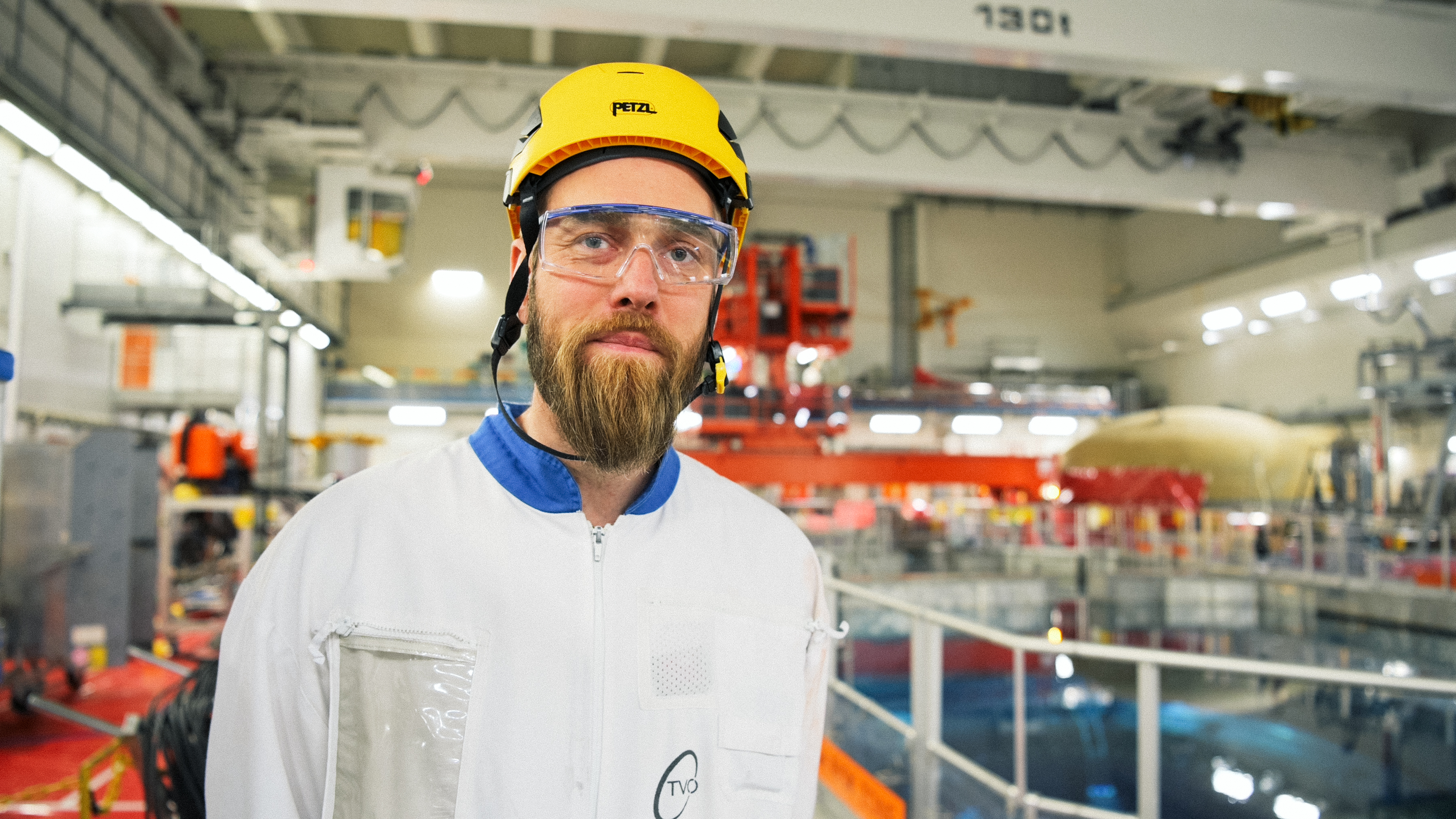
– The transfer machine is a crucial piece of equipment in the sense that the reactor fuel will not move in any direction without it, says Project Manager Kari Hakala who has worked in Olkiluoto since 2009.
This operation is crucial in terms of an overall successful service outage, because like every year, the outage also includes refuelling. And the transfer machine is a necessity in refuelling. Without it, reactor fuel cannot be moved in any direction inside the plant.
The significance of the transfer machine is reflected in it being referred to as a critical line machine in the outage terminology.
– In other words, it is one of the operations that determine the duration of the annual outage. If the transfer machine is inoperable, the overall outage is delayed, summarises Project Manager Kari Hakala.
Experience helps
This is not the first rodeo, or annual outage, for Project Manager Hakala. He has worked on the nuclear power island since 2009 and actually started his career by writing his thesis for Teollisuuden Voima. He has played one part or another in almost every annual outage since then.
The new transfer machine was put to a real test at the very start of the outage. The unloading of fuel from the reactor was started as soon as it became possible. All in all, about one week had been reserved for the unloading and transfer of the fuel. There was plenty to transfer, because ahead of the long service outage of OL1, the entire reactor core was emptied for maintenance activities. This operation was completed exactly on schedule.
According to Hakala, this being the second similar project within a short period time was very helpful to achieving this. At the Olkiluoto 2 sister plant, the transfer machine was replaced a year before.
– This is now the first service carried out on the machine in question, and the second for the OL2 transfer machine. It is becoming a routine procedure, Hakala smiles.
The transfer machine will again assume a big role towards the end of the outage, when the core of the plant unit is loaded with fuel for the upcoming operating cycle.
The period of time between unloading and loading is scheduled to include a bunch of tests designed to cross every “t” and dot every last “i”. This process has also benefited from development work being carried out on two similar pieces of equipment. This work has made good progress, as well.
– Last year we identified for the transfer machines 220 areas needing improvement, and so far we have addressed about 200 of them, Hakala explains.
However, there is still a lot to do even if the majority of the development activities have been completed.
– At the moment, we are still working on issues related to gripping the fuel and the optimisation of the handling sequence. They are minor finalising touches, but ones that we wish to accomplish, Hakala says.
Expecting also the unexpected
As this is to be the first time that the transfer machine is put to work, preparations have also been made for potential challenges. The French equipment supplier has a 24/7 presence in Olkiluoto and the design office in France is also involved in the maintenance operation.
– TVO is represented in this operation by, for example, a fuel engineer, a transfer machine operator and several experts in technology and testing, Hakala sums up.
The replacement of fuel transfer machines is not a common occurrence.
– This was the first time in the Nordic countries, and even on European level it has been a long time since a transfer machine was replaced, he ponders.
The work on the machine has therefore attracted interest also in Sweden.
– In Oskarshamn, this was implemented as a modification of automation, but Forsmark is about to choose the same solution as us. They have already invited themselves for a visit to learn from our experience, Hakala tells.
Previous machine was a high-duty piece
The predecessor of the current transfer machine served the plant for a respectable time, from the very start of the plant’s operation.
– Mechanically speaking, the old transfer machine was still original. It had been upgraded several times over the years, but in the end, the replacement of the whole system proved to be the best option, Hakala says.
The advantages of the new machine are clear. Compared with its predecessor, it features better safety logic and usability, which also makes semi-automatic operation possible.
– Another advantage is the shorter time needed for the overall process, Hakala adds.
Text: Ville Kulmala
Photo and video: Tapani Karjanlahti