Repair of turbine condenser front chamber one of major annual outage work activities at OL1
For Olkiluoto 1, the annual outage is this year exceptionally long, a total of 55 days. One of the main reasons for the long outage period is the extensive repair work on the front chamber of the turbine condenser which is now to be carried out for the first time in the whole history of the plant unit. This repair is one of the critical line work activities, meaning its completion will for its part dictate the total duration of the annual outage as a whole.
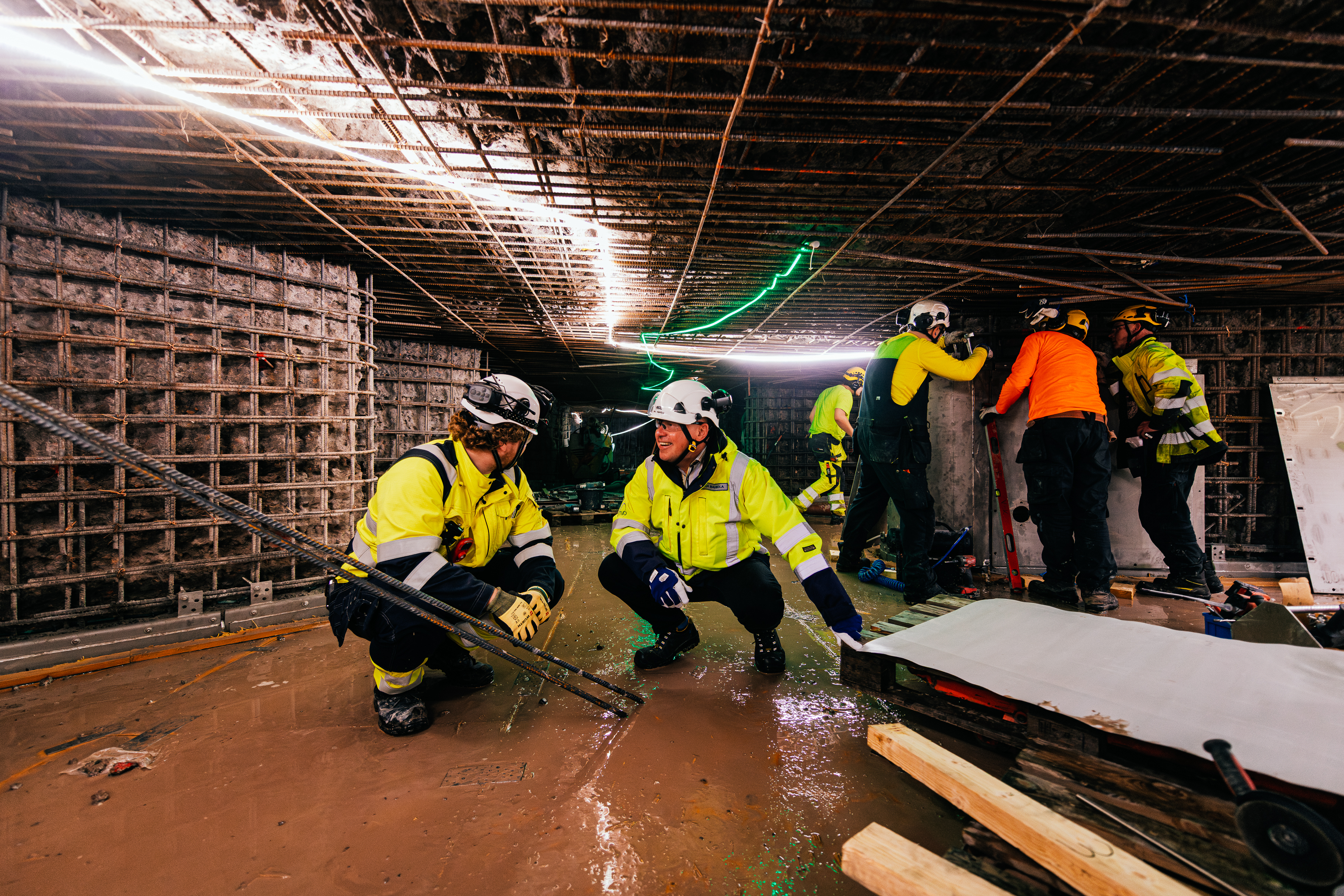
In the schedule, about 50 days is reserved all in all for repair work on the front chamber. Work started as soon as the annual outage started and is scheduled to go on over to June.
– As a project included in the critical path of the annual outage, it determines the length of the outage, summarises the Plant Modification Manager for OL1 and OL2, Mika Rahkola. He has acted as a stand-in for Project Manager Joel Niemi since the early part of the year.
-This was such a well-planned project with everything in place just right that it was really just ready, set, go for me, he praises the efforts of his colleague.
Seawater cools water back into water
The condenser plays a crucial role in the operation of the power plant. Once the steam has completed its job in electricity production by rotating the turbine, it needs to be cooled down into water for reuse in the process. In Olkiluoto, cooling takes place using seawater.
– The seawater enters the front chamber in four large inlet pipes and is then delivered further into the condenser. There the steam is cooled back into water, Rahkola shows the conceptual diagram.
The front chamber through which seawater runs and which is now being repaired is several hundreds of square metres in size, albeit a very low space. As this is the first time repair work is carried out on this space, the structures are all original. That means they are close to half a century old.
– The concrete structures have been affected by seawater, and in particular chlorides, over the years. That is the reason for the need to repair and replace them, Rahkola explains.
Assisted by robots
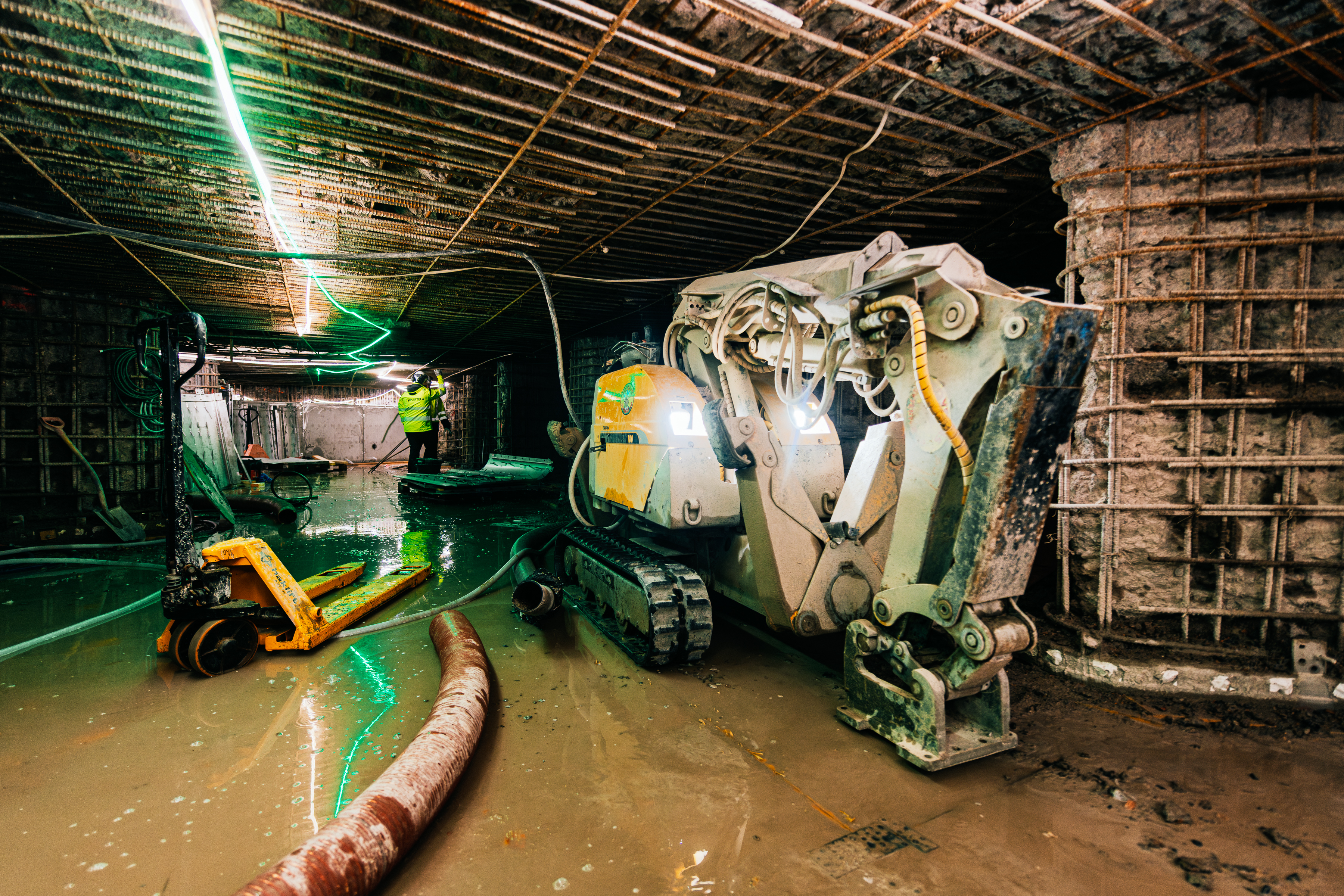
The first work phase is the removal of damaged concrete by means of hydroblasting where the old concrete is broken with an ultra-high-pressure water jet. This is a precise, selective and non-damaging, but not particularly gentle work method. Hydroblasting produces a huge amount of crushed concrete and moisture.
Most of this work phase is given to robots to perform. This is because they are multiple times more effective than humans in terms of speed. Also, the work conditions are far from optimum.
– The conditions are pretty harsh. There is a lot of moisture and projectiles flying about all the time, Rahkola describes.
At best, there were as many as three robots carrying out hydroblasting. And the amount to be blasted was truly large.
– The amount of work was larger than we had imagined. In places, concrete was removed down to 20–25-centimetre depth. All in all, about 150 cubic metres of concrete had to be replaced. Underneath, the old reinforcing also needed to be replaced and reinforced, Rahkola says.
Despite the larger than expected amount of work, the project has kept to the schedule. By mid-May, the robots had completed their work. The remaining water jetting work in places that require extra precision will be carried out by human hands in a still more traditional manner.
Three-dimensional puzzle in Olkiluoto style
Whereas until now the front chamber had a concrete surface, in the repair process it will be covered with a steel structure referred to as a “liner” by Rahkola.
– This liner looks a bit like an iglu made of metal. And the assembly work is also a kind of a puzzle, Rahkola chuckles.
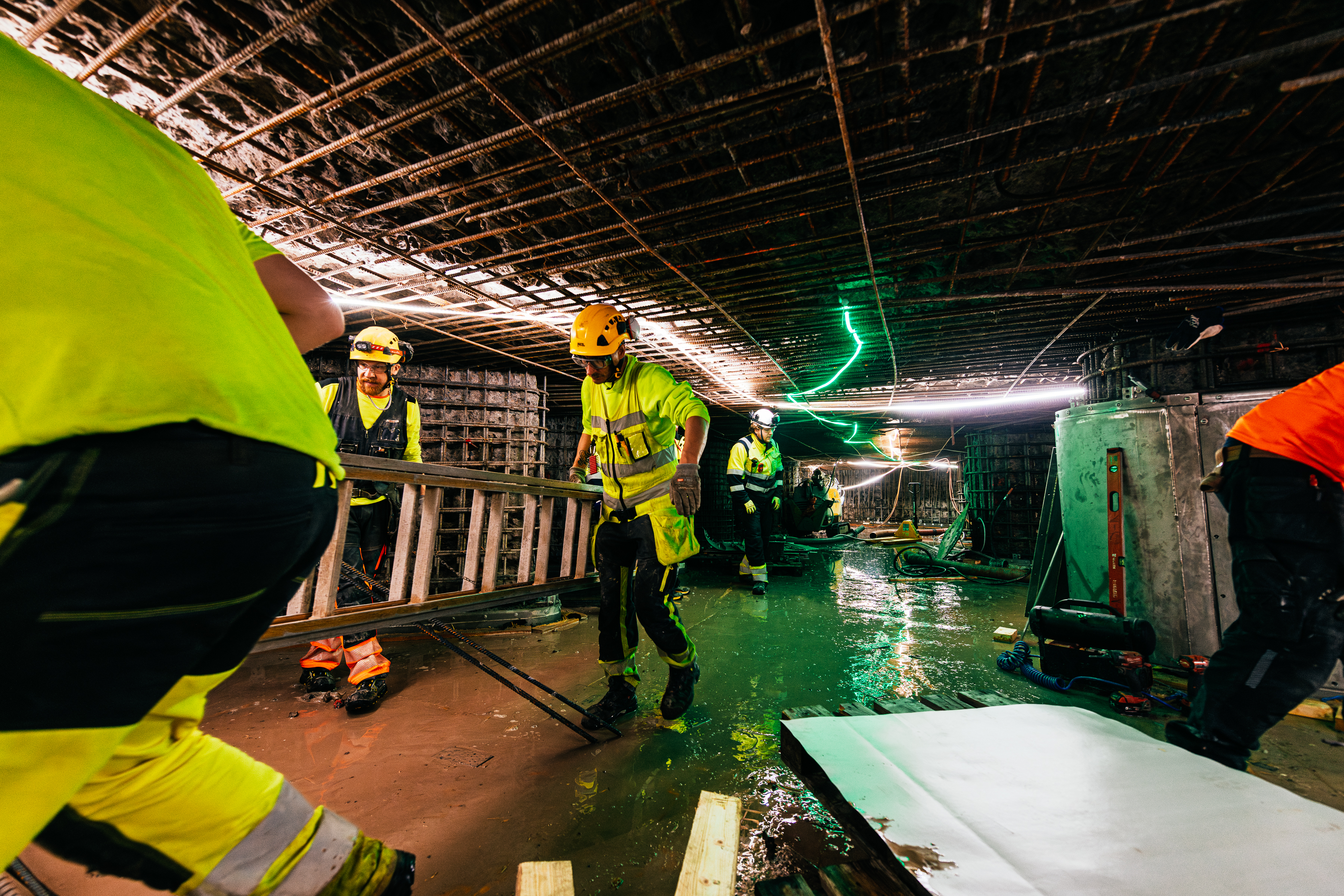
The liner consists of about 400 steel sheets assembled piece by piece on the chamber walls and ceiling. This will be followed by injecting concrete in the space between the steel liner and the original concrete wall.
The puzzle we are talking about is on the larger side, as a total of about 600 square metres of new liner surface is planned to be installed.
This will make the front chamber look completely different from before. The most important reason for this is to significantly improve the durability of the concrete.
– The duplex-steel used will in practice last until the end of the plant’s service life, Rahkola says.
Having had the opportunity to rehearse the operation beforehand helps. A mock-up space was even built in Luvia for this purpose.
– In practice, the whole structure was assembled there as a rehearsal for the actual installation work in Olkiluoto, Rahkola explains.
And a good thing that was, too, as the work requires extremely precise measuring and fitting. In some points, placing the structures is literary a game of millimetres. And having to carry out the entire operation in a space that is less than 160 cm high does not exactly help, either.
Surprises found inside structures
Despite the extensive preparations, surprises were also found beneath the old structures. Although in this case, surprises did not actually come as a surprise.
– When an old structure is opened, there are always surprises. In some places, the concrete and the reinforcing were in worse condition that anticipated, he starts.
As a result, we have been forced to change and develop the work phases along the way as situations have arisen.
– We have found new and better ways of doing things while at the same time making progress in the work so that all in all, we kept well to the schedule.
Worksite open 24 hours a day
In practice, the repair activities have continued uninterrupted since the start of the annual outage.
– The work is in practice carried out 24/7. The only breaks occur when we wait for concrete to settle. Not that we are lazy even during the breaks. Instead, we make preparations for the following work phase, Rahkola points out.
When everybody is counted in, there are well over a hundred people working at the different phases of the front chamber project. This includes a large number of various tradesmen from concrete builders to steel fitters and from scaffolding erection crews to cleaning staff.
Rahkola particularly emphasises the significance of team work.
– Cooperation has been very smooth between the different organisations of TVO, such as engineering, maintenance, operation and security. Not forgetting the contractors either who also deserve a thank you for good cooperation. We really have all worked for a common goal in this project, Rahkola gives praise.
At present, Rahkola names the concreting of the ceiling as the biggest challenge.
– The walls and the floor are quite straightforward, but the work phases involved with the ceiling are the most challenging ones. The mock-up rehearsal was a great help with that as well, he says.
Same job waiting also at OL2
The lessons learned during this year’s annual outages will be taken advantage of next year. The same front chamber repair project is to be carried out then at also the sister plant OL2.
The work carried now offers a lot of valuable experience for the future.
– We are learning more the whole time. We have already streamlined may work practices during this process, Rahkola says.
Text: Ville Kulmala
Photos and video: Tapani Karjanlahti