Impossible Until It Isn’t – What Posiva and Roger Bannister Have in Common
In my younger years, I was a keen track and field enthusiast, particularly drawn to middle-distance running. Even today, I still spend time coaching young runners in my hometown. Over the years, I have also read countless biographies and background stories of athletes — stories about persistence, setbacks and moments when seemingly impossible barriers were finally broken.I have always been inspired by these stories, and I believe there are lessons to be learned from them far beyond the stadium.

The world of sports is filled with great stories, but one story in particular has always stood above the others for me.
We have to go back more than 70 years. In 1954, British runner Roger Bannister achieved something that for years had been considered impossible. He ran a mile in under four minutes.
And it was not just a major athletic achievement — it fundamentally changed perceptions. At the time, many experts genuinely believed the human body was simply incapable of doing it. The limit was seen not merely as difficult, but physiologically unreachable.
Yet once Bannister crossed that line, something remarkable happened. The barrier that had seemed immovable suddenly disappeared. Within months, other runners followed. Today, more than a thousand athletes have achieved the same milestone. So what happened?
It is clear that human physiology was not the reason for the progress. Evolution certainly does not happen that quickly. And although there is no doubt that developments in equipment, training methods and coaching knowledge have been remarkable over the past 70 years, they still do not fully explain the speed of the progress. A shift in attitudes, on the other hand, does explain it. Once one person proved it could be done, others quickly followed.
To me, this feels very familiar. I believe strongly that the nuclear industry is now approaching a similar turning point.
For decades, the final disposal of spent nuclear fuel has often been described as the unresolved question of nuclear energy. Since the dawn of the industry in the 1950s, critics and supporters alike have asked the same question: what should we do with the spent fuel?
In Finland, we are now moving from theory toward practice. And we at Posiva, located in Olkiluoto, Finland, are actually very close to crossing the finish line.
After decades of research, development, testing and construction, the systems and facilities are nearing completion. The encapsulation plant (above ground) is essentially ready, and the Trial Run of encapsulation plant has already been successfully completed. Underground installation vehicles' tests and preparations are continuing as planned, the tests in above ground test hall are currently on-going and after that they will continue in underground environment.
For us in Finland, this is naturally a historic moment. But I believe it could also become a turning point for the entire global nuclear sector.
Because once one country demonstrates that final disposal can be carried out safely and responsibly in practice, the tone of the entire conversation changes.
Getting There
Much like Bannister’s mile, the challenge itself does not suddenly become easier. Geological disposal still requires decades of scientific work, political commitment, regulatory oversight and public trust. None of that disappears.
All of these elements will remain essential for future final disposal projects as well. But the psychological barrier changes fundamentally once the first successful operational example exists.
And trust is ultimately at the centre of all this.
I honestly believe nuclear energy depends on trust perhaps more than any other industry. Trust between operators and regulators. Trust between political decision-makers and citizens. Trust that long-term commitments will be honoured over generations.
In Finland and the other Nordic countries, this trust has been strengthened by stable democratic institutions, transparency and open dialogue.
Public acceptance for nuclear energy in Finland is today at historically high levels. And I am also proud to say that, at the same time, Posiva’s own reputation has reached record highs according to recent surveys.
These developments are not coincidences. Trust is not created by silence. Open communication has been at the heart of the Olkiluoto site ever since the first units were built in the 1970s.
No Room for Shortcuts
The Nordic approach to nuclear energy has, from the very beginning, been built around one fundamental principle: responsibility does not end with electricity generation. It must cover the entire lifecycle.
This principle has guided the development of final disposal for decades.
There have been moments when progress felt painfully slow. But in an industry where safety is absolute, there are no shortcuts.
Now, however, the final stretch is approaching. And perhaps the most important thing about crossing the finish line is not only what it means for Finland. It is what it demonstrates to the rest of the world.
Once the impossible has been proven possible, others tend to follow.
And that is something I sincerely hope to see.
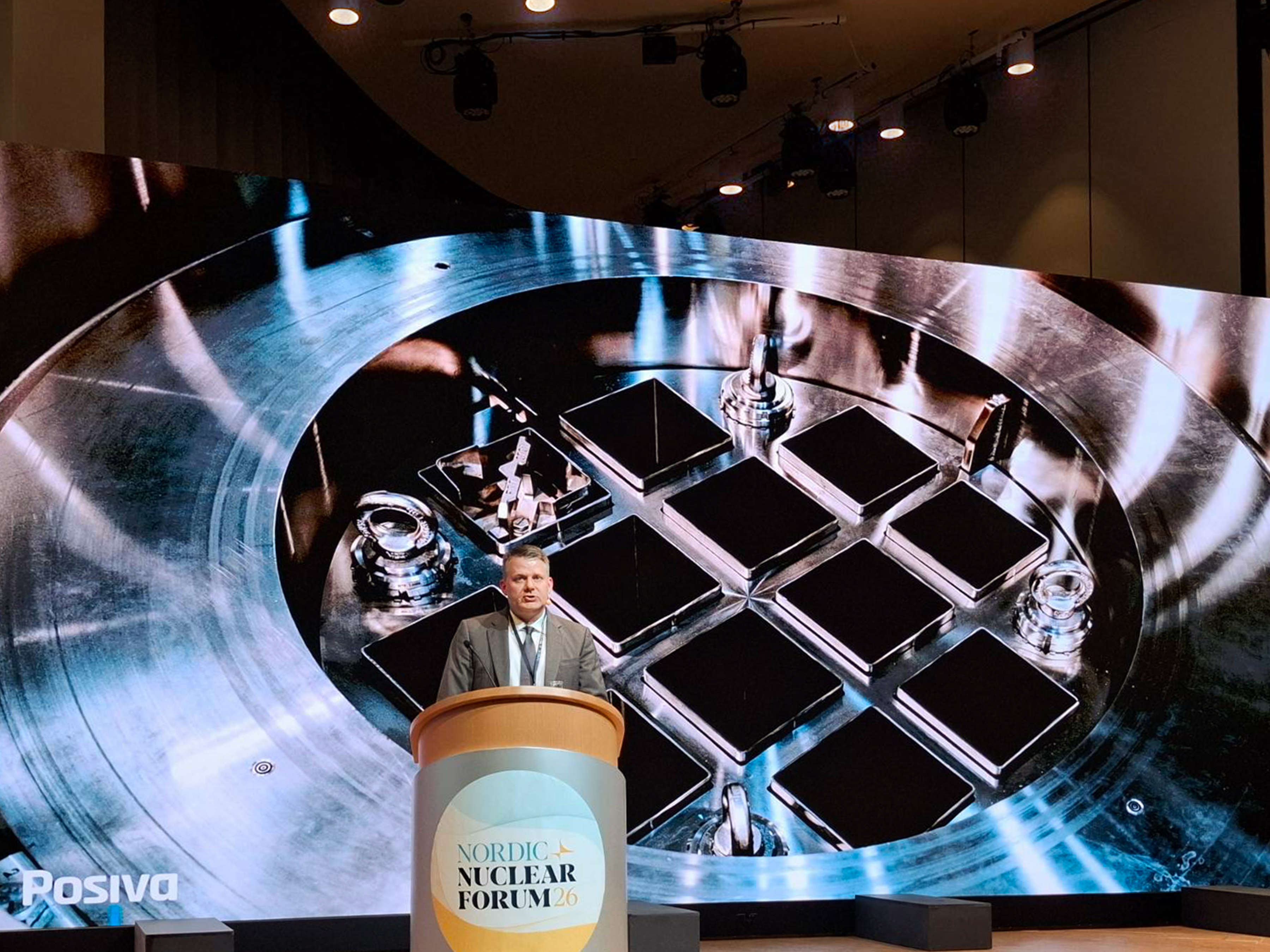
Text is written by Ilkka Poikolainen, the CEO of Posiva. This opinion article is based on his speech at the Nordic Nuclear Forum event in Stockholm.
Kuvat: Tapani Karjanlahti ja Juha Poikola