Employee health is worth the investment
Well-being is essential both at the personal level and from a business perspective. Jaana Isotalo, Teollisuuden Voima’s (TVO) Senior Vice President of HR and Communications, believes that the prevention of lifestyle diseases, in particular, makes financial and human sense. TVO wants to invest strongly in employee well-being, and to help with these efforts, the company has implemented new Finnish technology – which certainly caught the employees’ attention in this engineer-dominated industry.
Today, taking care of personal health and employee well-being is perhaps more relevant than ever before. Many employers are currently thinking about what kinds of investments they should be making and which preventive efforts would yield concrete benefits. This was something that we also discussed at Olkiluoto while planning the measures for 2025 and thinking of ways to get the employees engaged in their well-being.
By and large, our sickness absences have been at a good level, and we have been classified into the very low risk category in terms of incapacity for work, for example. Last year, our sickness absence rate was 2.5, which is a low number on the national scale. However, we are aware that risk factors related to the employee age structure and lifestyle can subject our personnel to lifestyle diseases. These ailments, such as cardiovascular diseases, type 2 diabetes and musculoskeletal disorders, are common in Finland and result in significant costs to employers and the larger society each year.
In the nuclear industry, we focus on incident prevention rather than clean-up, and we also apply this philosophy to the health and well-being of our employees. Here, too, prevention is always easier and more affordable than treating problems only after they occur. In recent years, various technical innovations that contribute to prevention have emerged in Finland. We employ a large number of engineers and technical professionals at Olkiluoto whose everyday work is guided by data and verifiable facts. Knowing them, I believe that such fresh technological solutions will attract their interest. But how can we combine this with our goal of promoting employees’ intrinsic motivation for their health?
It just so happened that there was timely news coverage about a new Finnish success story, the MedicubeX eHealth Station™ that makes it possible to screen for working capacity risks quickly and easily, right at the workplace. The idea was immediately well received, and the collaboration between occupational health care and MedicubeX progressed rapidly to implementation. The world’s first eHealth Station deployed to occupational health care was installed at Olkiluoto, Eurajoki in early September 2025 for use by the nuclear power plant’s personnel.
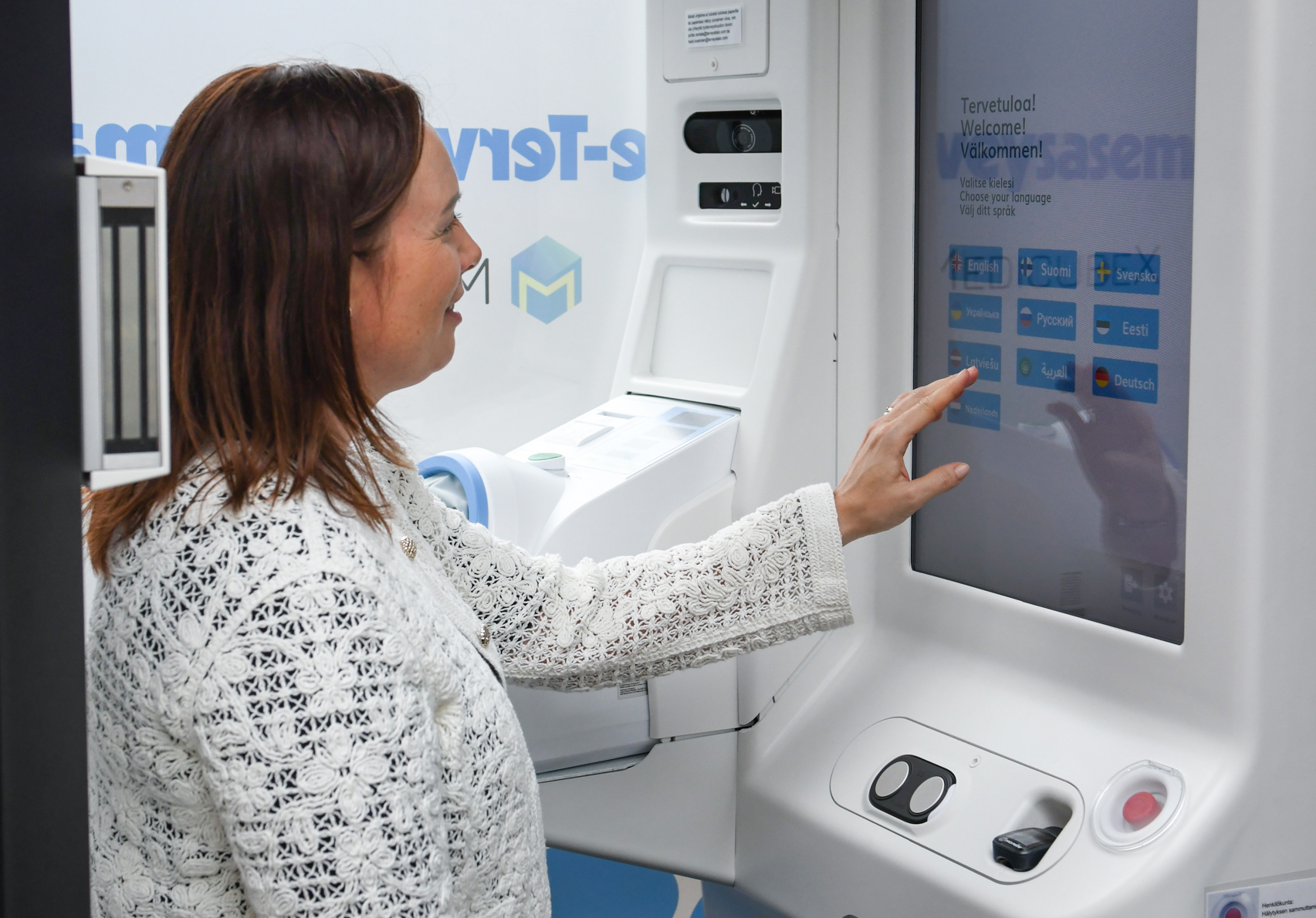
Now that several months have passed since its introduction, I can say that the interest has been incredible. The station had more than 750 sessions over the first few weeks, and the start of a new year brought with it a new wave of visitors. The health check takes approximately five minutes, and the station then prints out the measurement results and a risk analysis. After this, the user is recommended either to continue voluntary check-ups at the eHealth Station or to seek guidance by a professional. For now, the guidance by occupational health care has not been utilised very much.
The impact of lifestyle changes becomes visible over the long term, and we want to develop the partnership between occupational health care and MedicubeX in a way that increases our understanding of our employees’ health. At the moment, the results from the eHealth Station are not transferred directly to occupational health care, as we wanted to first try out the system and develop the overall implementation according to our employees’ requests. According to our recent survey, our employees are also in favour of having the option of submitting the results directly to occupational health care. This would lower the barrier of receiving help with lifestyle changes from occupational health care professionals.
I believe that, in the future, innovations like this can be a part of health checks or supplement the statutory check-ups. They can reduce the time spent by an occupational health nurse and improve tracking. This spring, we have also introduced the eHealth Station for health checks – as an optional component for now. When a person is due for a check-up, we ask them to first visit the eHealth Station and then take their results with them, so that they can be reviewed by a professional.
From the employer’s perspective, supporting employee health is an investment in better productivity and working capacity. The prevention of lifestyle diseases and improving your energy levels contribute to stress management and employee satisfaction. For us, maintaining employees’ working capacity is a clear competitive advantage that attracts competent experts and engages current employees.
Wishing you all good health,
Jaana Isotalo
Share