Ilkka Tammela is literally a man of thousands of fish
Fish are an essential part of Ilkka Tammela's job, but he mustn't talk about the one that got away. The fisheries scientist, who started his employment in Olkiluoto at the turn of the year, is tasked with analysing the type and amount of fish carried into the power plant in cooling water. Now that we have three plant units in operation instead of two, a new study is topical.
The ruler and the precision scale on Ilkka Tammela's desk are actively used and occasionally he will need a microscope, too. They all help to produce an accurate analysis of the fish stock in the area near Olkiluoto.
Tammela's work is a one hundred percent match to his training. He graduated from the University of Jyväskylä majoring in aquatic sciences and specialising in fish biology.
New plant unit reason for the timing
TVO is required to provide the fish stock report under the water permit granted to the power plant. The permit requires a study to be conducted of the fish and hatchlings that enter the power plant in the cooling water. The last study was carried out in 2010. However, the one that has now been conducted is more detailed than the previous study.
- Hatchlings have now been included in the report as a new topic of interest. Hatchlings were not analysed in the previous study, but now all fish are included, even the ones less than one centimetre in length, Tammela says based on personal experience. He was involved also in the previous corresponding study carried out in 2009–2010.
The timing of the recent study conducted by Tammela is explained by the brand-new power plant unit.- The study is scheduled for implementation now after the commissioning of OL3 and it will need to be repeated no later than four years after the start of the plant unit's commercial operation, Ilkka Tammela explains the background.
Precision work
Samples of fish are collected from the flushing channels of the service water buildings at all three plant units.
- OL1 and OL2 are equipped with fish screens and OL3 with a fish screen trap, Tammela presents the equipment.
However, they are not designed to catch only fish. All the screenings carried in the cooling water accumulates in them. The screenings consist of algae, molluscs and fish, but also of aquatic plants and polyps. And it is the analysis of these screenings than plays a key part in Tammela's work.
- The operating personnel gathers the screenings for me to sort and analyse, he explains. Quite a large number of fish end up for the analysis – some of them really minuscule. And those are the ones that the microscope is needed for.
- So far there has been no need for the microscope, the scientist admits.
Officially the purpose of the study conducted by Tammela is to establish the amount, biomass and species of the fish carried in the cooling water. Their length and weight distributions are also determined.
- The objective is to establish the average quantity of fish as well as their average weight in grams in every cubic metre of water pumped into the plant. This allows an estimate to be calculated of the total quantity and weight during the whole year.
The proportion of molluscs is also determined. Some of the molluscs are so tiny that a specialist in the field must be consulted to define their species.
Landing nets have also their use
Samples of screenings are collected in the service water buildings of the power plants over randomised time periods. This produces a more comprehensive picture.
- We noticed in the previous study that the time of the day may affect the quantity of fish entering the power plants. At night time, the number of fish is greater than during the day.
During the first months, valuable fish have only been found in the screens in relatively low numbers.
The species that primarily accumulate in the screens include smelt as well as three- and ten-spined stickleback. At times, also gobies, perch, ruffe and straight-nose pipefish have been found in abundance.
In addition to the samples of screenings, the scientist also takes samples of hatchlings from the intake water channels of the plant units on a regular basis.
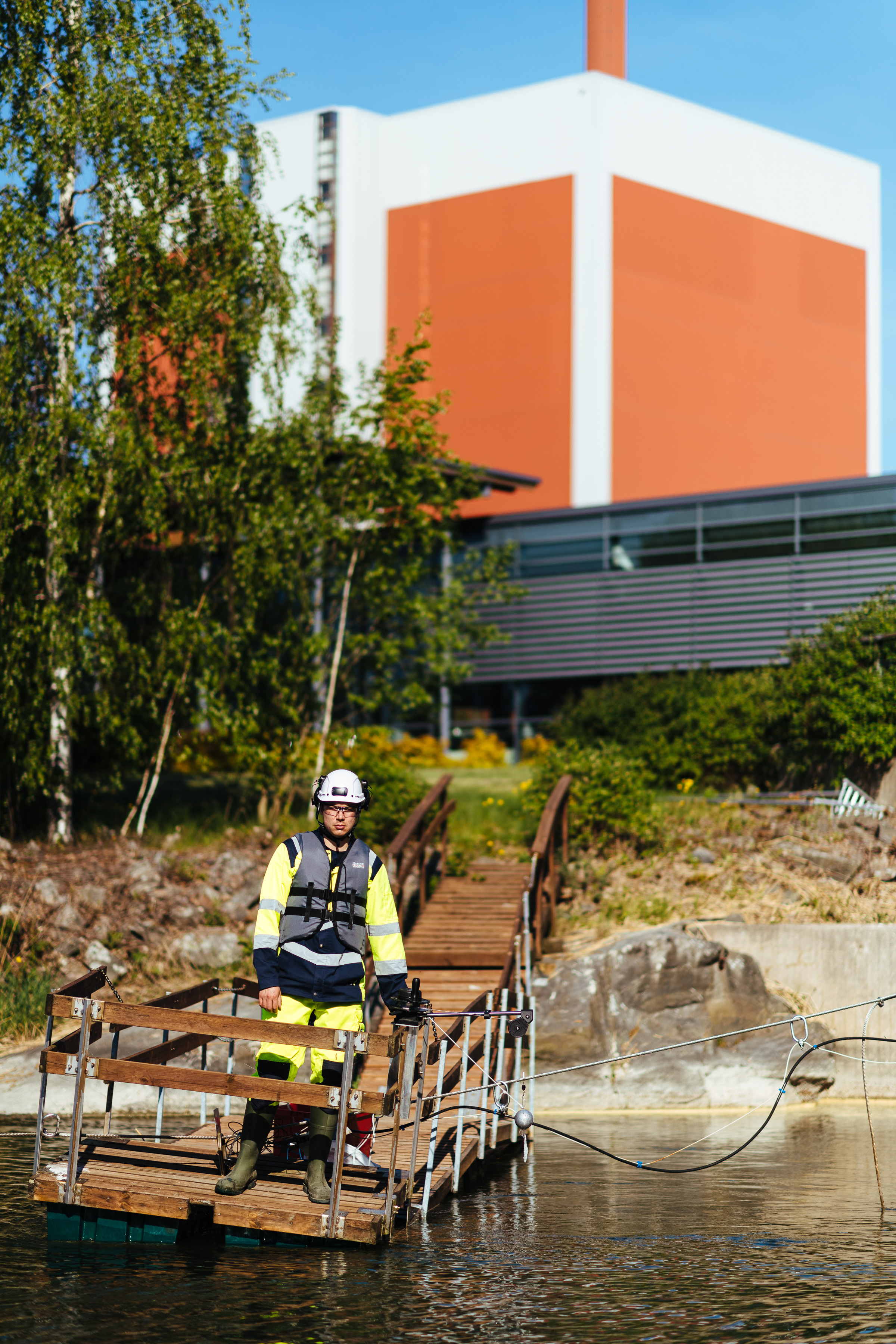
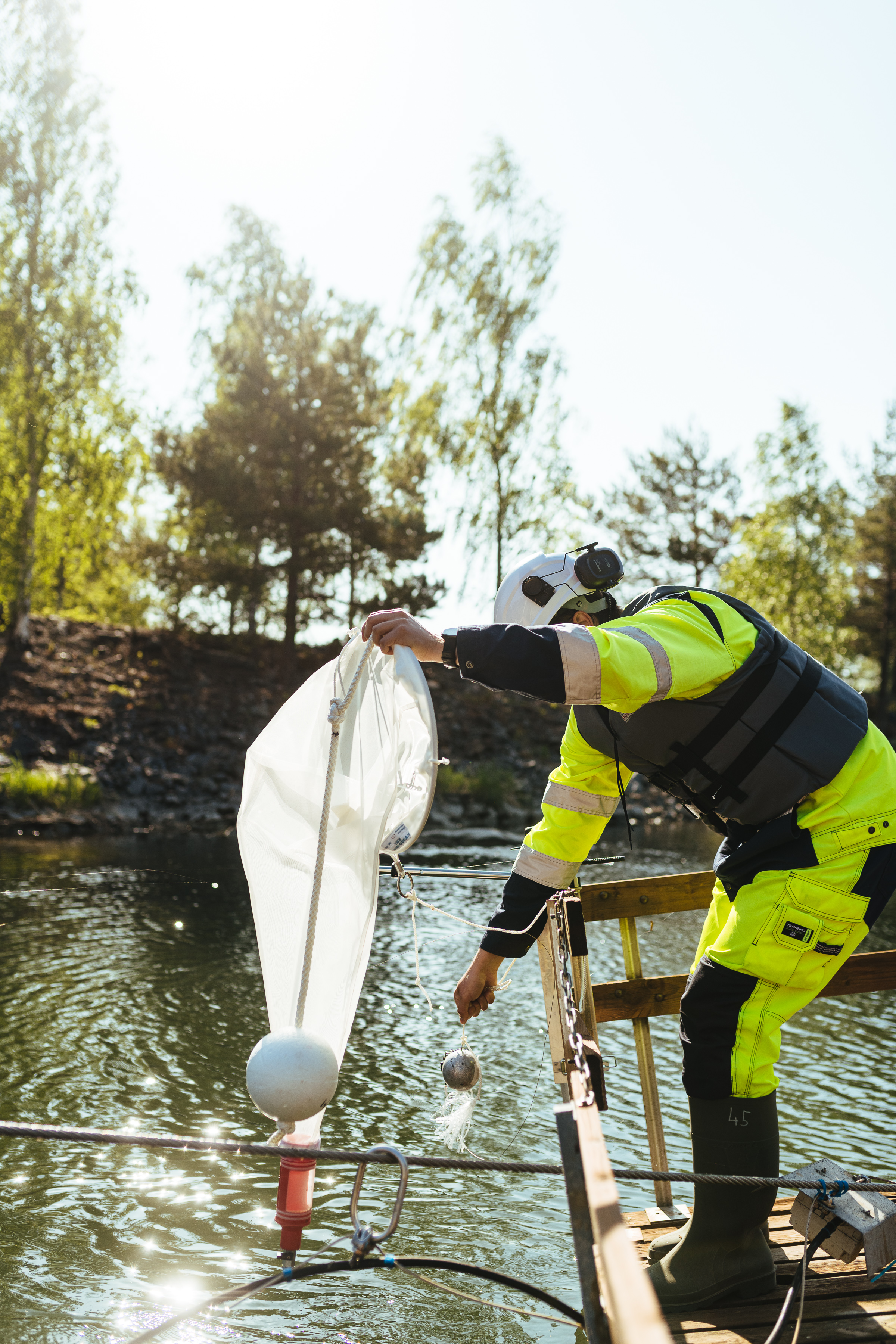
At OL1 and OL2, plankton nets lowered by means of rigging at various depths into the cooling water channels have been used to determine the quantity and type of hatchlings under 2 centimetres in length. The net has been lowered from wooden piers provided outside the coarse screens.
- In the intake channel at OL3, we have tried to catch hatchlings by towing a net from a boat, but also there we have had no success so far. This is something I cannot do alone, but have on these occasions been assisted by Juha Luonto, Tammela says.
First samples were collected in March
The first samples of the screenings for this particular study were taken for an analysis by Tammela in early March at the two older plant units. At OL3, sampling commenced on 17 April, just one day after the start of regular electricity production at the plant unit.
The first samples of hatchlings taken outside the plant were collected in April. In fact, the attempts to collect hatchling samples started at OL1 and OL2 already on 5 April. At OL3, the first hatchlings were sampled with the help of a boat on 28 April.
The aim is to continue to collect samples of hatchlings for as long as any hatchlings are found in the cooling water.
The results of the study are reported by Tammela to the Centre for Economic Development, Transport and the Environment. Every year, TVO pays a fisheries fee to the Fisheries Authority to be used to reduce the adverse effects of the cooling waters in the area affected by them.
Text: Ville Kulmala
Photos: Tapani Karjanlahti
Share