Esteemed Award for promotion of nuclear safety
Mikko Kosonen's career in executive positions at Teollisuuden Voima lasted for more than 38 years. He values high the role of the World Association of Nuclear Operators, or WANO, in the improvement of nuclear safety.
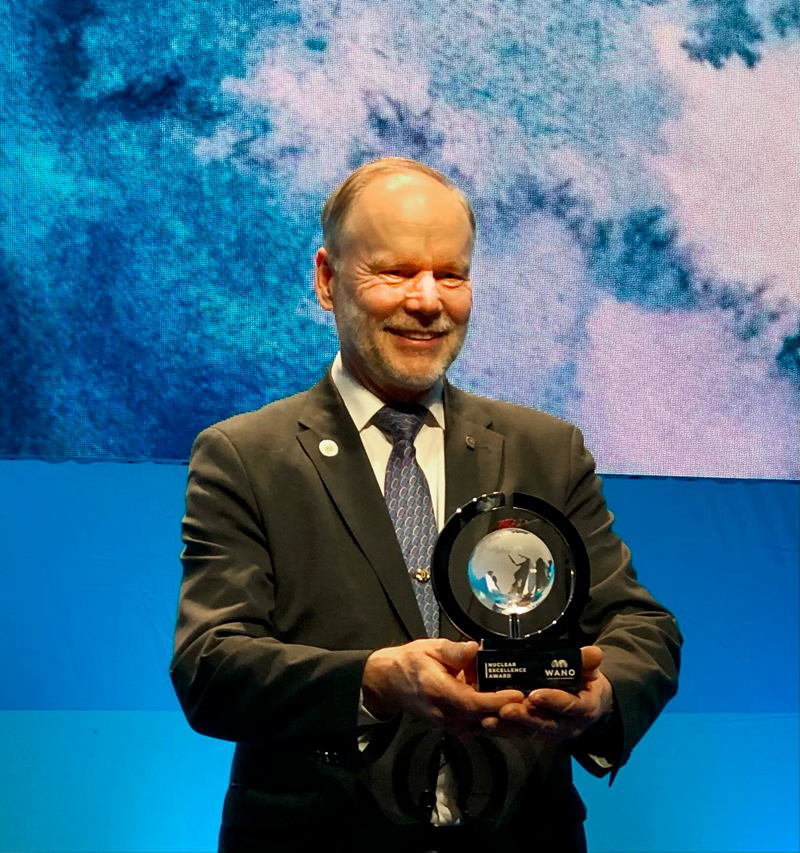
Mikko Kosonen has enjoyed his retirement since last summer, after a long career at Teollisuuden Voima in executive positions. The last few months of his employment he worked as Corporate Advisor. The nuclear industry managed to surprise Kosonen one more time: the World Association of Nuclear Operators, WANO, granted him the esteemed Nuclear Excellence Award which could be described as the Academy Award in the nuclear industry.
WANO has since 2002 granted personal awards to nuclear industry experts who in their work have made a great contribution to the promotion of nuclear safety. The Award was handed to Kosonen in an event held in Prague in October.
– Naturally, I was pleasantly surprised by WANO's recognition, Kosonen says.
Mikko Kosonen, MSc (Eng), has a background in the nuclear industry that goes way back. In early 1980s, the then student of nuclear power technology in Lappeenranta University of Technology (now Lappeenranta-Lahti University of Technology, LUT) asked Ilari Aro at TVO about a summer job. And got a job.
– My first summer job was in TVO's Espoo Safety Office in Kilo in 1982. The summer job also involved supervision of refuelling during the annual outage in Olkiluoto. The following summer I continued working as a refuelling supervisor in Olkiluoto and in 1984 transferred to the Safety Office to write my thesis on the optimisation of Technical Specifications (Tech Specs).
Kosonen's career has included managerial roles in the Department of Operational Safety and at the OL1 and OL2 plant units as well as the position of Senior Vice President for Safety and Security Services.
Chernobyl disaster pushed forward efforts for nuclear safety
WANO was established after the accident at Chernobyl nuclear power plant to improve safety in the nuclear sector. Membership is voluntary, but all electricity-producing nuclear power companies in the world have joined the Organisation.
The operation of WANO is dedicated to Nuclear Excellence through the principle of continuous improvement.
– The Fukushima nuclear power plant accident, which happened after WANO was established, caused the Organisation to further intensify its operation. The cause of the accident was a natural disaster, but in hindsight, the consideration of the possibility of an earthquake and the subsequent tsunami in plant site engineering could have prevented the accident.
Peer reviews a key tool
WANO has four main programmes, the most important of them the peer review. In a peer review, experts from other nuclear power companies and WANO review the operation of the plants at intervals of four years. The objective is to help the nuclear power companies to benefit from the best practices in the industry.
– In the review, the operations of the nuclear power company are assessed through expert observations and interviews, not just based on documents. Based on the peer review, the nuclear power company is given recommendations for the development of operations. Two years after the peer review, WANO checks the progress the company has made in implementing the recommendations, Kosonen explains.
Transparency is a key element of WANO's activities. Nuclear power companies provide information to the Organisation on the operation of the plants and WANO reacts to any non-conformances by giving new recommendations. The members openly share proven best practices in the industry between them.
– WANO recognises that an accident in any nuclear power facility will always have repercussions in a wider geographical area, not only in the actual country. When conditions in the society are normal, nuclear power plants are safe. But even nuclear facilities can be destroyed by acts of war.
Nuclear power companies send their own experts to WANO's regional centres to work in positions related to nuclear safety. WANO has regional centres in Paris, Moscow, Atlanta and Tokyo.
The WANO Governors' meetings play an important role when issues related to nuclear safety are addressed. Kosonen has represented TVO in WANO Governors' meetings in 2009–2022. The role of the governor is always vested in the company which then appoints a person to represent it.
– It is clear that WANO's long-term efforts have increased transparency in the nuclear industry as well as mutual trust between the professionals operating in different countries.
Safety is based on continuous development efforts
Kosonen views continuous development as a good tool for the nuclear industry to improve the safe operation of the plants.
– During my time in senior positions at the OL1 and OL2 plant units, there were several thousands of procedures in place for the operation of the plants. WANO brought up in the peer reviews the need to provide more concise guidelines to the personnel, e.g., in regard to expectations related to the quality of operation and safety culture. This requirement was based on the observations made in the peer reviews.
More concise procedures were provided, first as "production expectations" and later as "management expectations", but further need for improvement was identified in the reviews.
– We then had an epiphany, the credit for which goes to Development Manager Essi Vehmanen. We adopted a more personal approach in the procedures and introduced the concept of professionalism in nuclear industry. The basic idea being that safety starts with the work of every professional.
Annual investments in the OL1 and OL2 power plant units have amounted to some EUR 50 million. The objective of the massive investments has been to keep the plants in as good as new condition.
– At present, TVO's operating licence for the OL1 and OL2 plant units runs until the end of 2038. If they are decommissioned after that, the rational way to proceed is to optimise maintenance and cut down on investments. A whole other question is how the production of OL2 and OL2 can be replaced, if they are taken out of operation, Kosonen reflects.
Involvement in work for a fifth nuclear power plant
Mikko Kosonen was one of the experts involved when a fifth nuclear power plant was on the agenda in Finland.
– The project started in late 1980s was buried in 1993 due to political opposition. When the project was revived at the end of 1990s, I visited San José in California to conduct a feasibility study on the ABWR plant tendered by General Electric.
The European pressurised water reactor, or EPR, won the contest for OL3.
– I was later part of the OL3 project in the recruitment of Shift Supervisors and operators. Today I can say that we picked good people: most of the individuals recruited at the time are still in TVO's employment and many of them work in the OL3 control room.
Kosonen chuckles when asked how he intends to spend his time in retirement. Being a member of Posiva's safety team and Loviisa nuclear power plant's Nuclear Safety Committee means he has not cut his ties to nuclear safety issues. There are things to do outside the nuclear sector, as well.
– I am an heir to an estate that owns a property in Savonlinna where there is no shortage of work: management activities of forests and young stand, as well as chopping wood for heating. My daughter and I recently planted 700 new pine trees due to snow damage. Occasionally I engage in water activities, boating and fishing. Golfing and participation in Rauma Rotary Club also ensure that I do not get bored.
Text: Timo Sillanpää
Photos: Natalie Kylliäinen, WANO
The story was previously published in TVO Group's Uutisia Olkiluodosta news magazine.
Share