12 March, 12:01 hours
This spring has been a time of memorable and historic moments in Olkiluoto. Electricity production started at the Olkiluoto 3 plant unit on Saturday, 12 March 2022, at 12:01 hours, at a power level of ca. 103 megawatts. "Everything went smoothly, just as we anticipated", concluded OL3 Shift Supervisor Janne Rouhiainen.
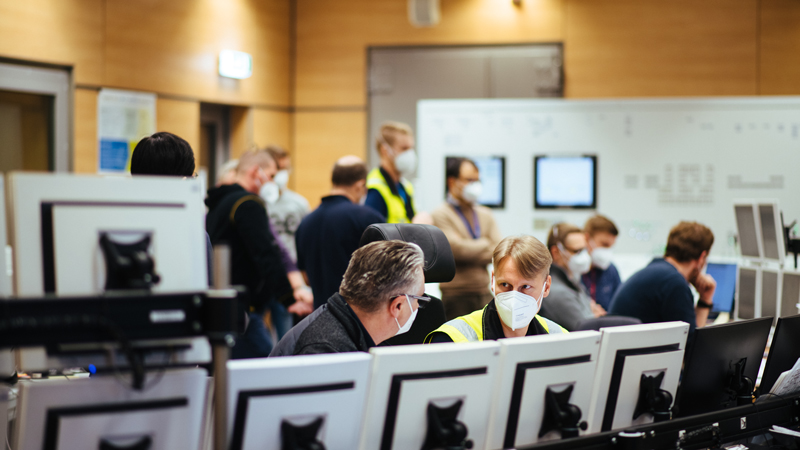
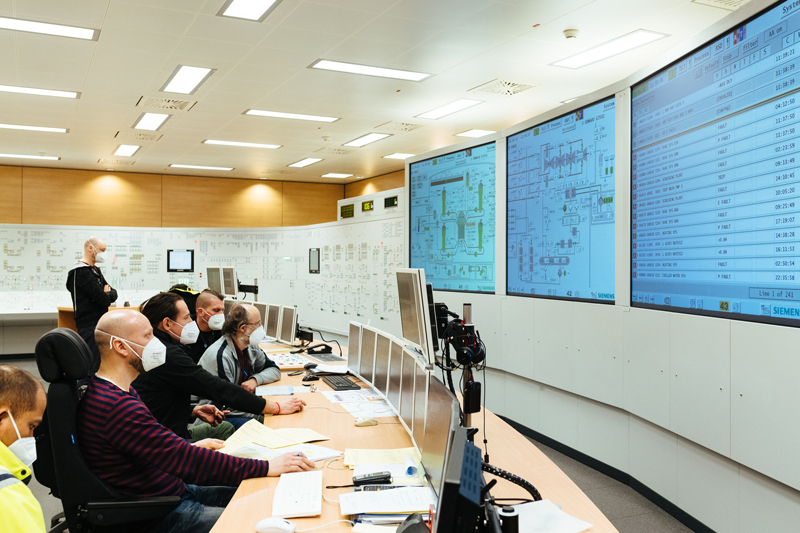
The OL3 main control room was on 12 March the scene of the long-awaited moment of the start of electricity production. Almost two dozen nuclear professionals witnessed the synchronising of the new power plant to the national grid. In addition to Teollisuuden Voima's own experts, the attendees included representatives of the Radiation and Nuclear Safety Authority of Finland as well as Areva and Siemens. The previous important milestone was reached in the project on 21 December with the start-up of the OL3 reactor.
The synchronising to the grid took place a few minutes after the automatic synchronisation system had been activated. The atmosphere was professional and focused, and the emotions of the attendees were concealed by the face masks and impossible to read, even when the synchronisation of OL3 to the grid was verified to have been successful.

Shift Supervisor Janne Rouhiainen described his own feelings after the historic work shift.
– The successful synchronisation to the national grid felt like receiving an award for years of work. I am glad I had the opportunity to witness the momentous event and I believe it is something I will remember for the rest of my life. And you could sense the feelings of those present, when at the crucial moment everything went smoothly.
Having started training at TVO for operational activities at OL3 in March 2005, Rouhiainen himself had been preparing for this moment for 17 years.
– When the construction schedule of the plant was delayed, I was given the opportunity to work in the OL3 project representing the views of the operational staff, for example. During the years, the technology of the plant has become familiar, but the unit as a whole is so massive and complex that nobody can know everything about everything.
– The past few years have been particularly intensive with the plant nearing completion, piece by piece, and the start-up of the various technical systems.
Like driving on an on-ramp to the motorway
In order for the power plant generator to be connected to the national grid, it was synchronised to the 50 hertz grid frequency. Rouhiainen compares the synchronisation of the power plant to traffic: a motorist driving on an on-ramp to the motorway must accelerate to the right speed to merge in the traffic flow.
The automatic system decided the moment when the plant was ready to be connected to the grid. The generator switch was then closed. The plant remains disconnected from the grid for as long as the generator switch is open. In that state, the turbine speed can be changed and various tests carried out, for example. A few brief connection tests to the grid had been conducted prior to 12 March.
– After grid connection, we carefully monitored the performance of the plant in actual electricity production and during power ascension. During the current test production phase, we carry out many different tests before the start of commercial operation, so there is still a lot of work to be done, Rouhiainen says.
OL3’s turbine has a steady speed of 1,500 revolutions per minute during operation. The supply of steam to the turbine is increased gradually to produce the force needed to increase generator power.
During the test production phase, the power level is gradually increased to 1,600 megawatts. Power levels are fluctuated during test production. The tests carried out during the test production phase include e.g., the disconnection of OL3 from the grid and how this affects the operation of the plant and the status of the grid.
– One of the major tests carried out so far has been the so-called LOOP test (Loss Of Offsite Power) during which a planned loss of offsite power took place at the plant. The purpose of this test was to test the safety functions and the emergency diesel generators of the plant as well as the shut-down of the plant process. The test went well, Rouhiainen explains.
According to Rouhiainen, the start of normal day-to-day duties of the Shift Supervisor in the OL3 main control room is only a few months away. Each shift is 12 hours long and the shift team consists of the Shift Supervisor and three operators. There are also six field operators in the shift team. They conduct inspection rounds at the plant to monitor plant operation, respond to alarms and carry out various periodic tests.
– Waiting for the normal working days to start, Rouhiainen smiles.
Plant output during the test production phase can be followed on Teollisuuden Voima's website at www.tvo.fi/ol3forecast
Text: Timo Sillanpää̈
Photos: Tapani Karjanlahti
Share